

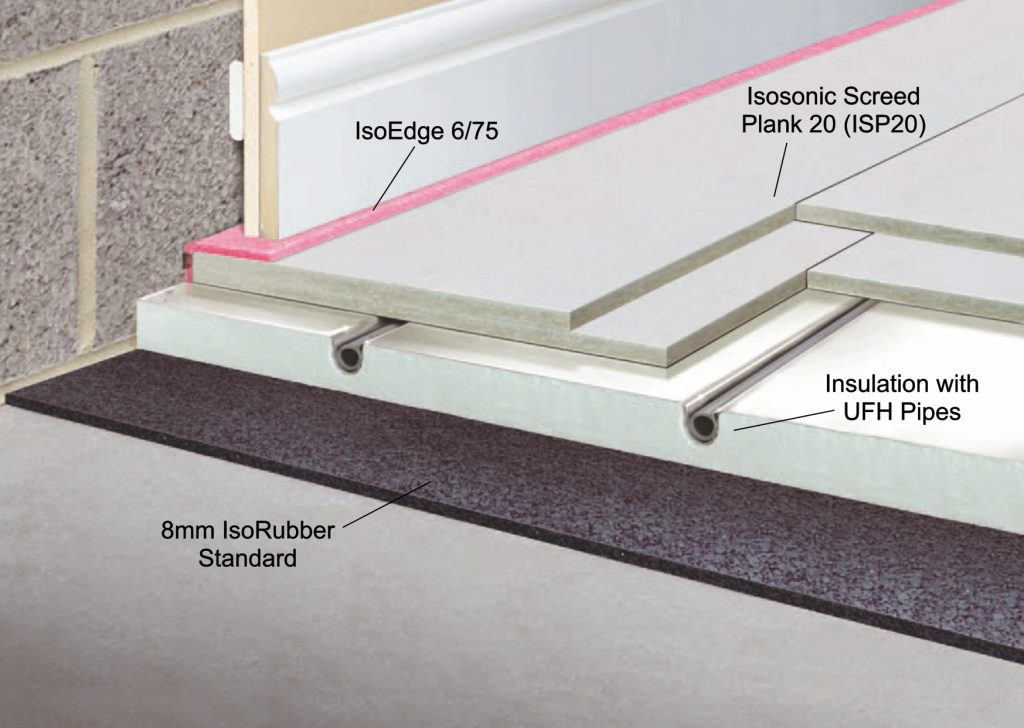
With the Future Homes Standard, the construction industry will be discouraged from new gas boiler installs and the government will promote electrification through air-source heat pumps and direct electric heating instead. Air-source heat pumps usually require a low-temperature heat distribution system, which can mean either larger radiators that take up more space, or an underfloor heating system. Whilst underfloor heating can offer more living space and more efficient heating, it does also have a few more challenges to the install because pipework is laid across the entire floor area rather than just at room perimeters; but our Thermal Economics Isosonic Screed Plank is easy to use with wet underfloor heating systems.
Phasing out of gas boilers
The original plan for the Future Homes Standard was that gas boilers would be banned in new-build homes from 2025 but delays to the introduction of the Future Homes Standards and the Labour government’s watering down of their Warm Homes Plan leaves one to wonder whether boilers will be banned at all. The intention of the Future Homes Standard was not a legislative prohibition, but targeted metrics towards net-zero carbon emissions in a way that it is not likely that gas boilers will be able to comply with the proposed new building regulations, particularly the target CO2 emission rate and the target primary energy rate. We still don’t know what will be in the final version of the Future Homes Standard, which we expect will be published at the beginning of next month but anticipate that most housing developers will make the switch to specifying air-source heat pumps with continuously running, low-temperature radiators and underfloor heating systems.
We also anticipate a rapid increase of boiler replacements with air-source heat pumps under the Warm Homes Plan, which will provide up to £2.7 billion funding into the Boiler Upgrade Scheme over the next four years to replace boilers with low-carbon technologies in existing homes. Alongside the Boiler Upgrade Scheme, £5 billion will be distributed via the Warm Homes Fund, of which £1.7 billion will be used to invest in low and zero-interest consumer loans for retrofitting energy efficiency measures such as heat pump installations.
Replacing boilers with heat pumps will be able to save even more on energy bills with photovoltaic panels especially if a solar diverter is also installed because electricity generated by the photovoltaic panels can be used to run the heat pump.
Solar diverters are a technology used to divert unused electricity from photovoltaic panels to a particular appliance, such as a smart hot water cylinder, rather than exporting to the main grid.
We still do not yet know how much electricity will be required to be generated by photovoltaic panels on new-build homes; and we will not learn that until after the publication of the Future Homes Standard, but we know that with the government’s target for net-zero emissions by 2050, it’s a very likely scenario that all new-builds will need them. Air-source heat pumps will be continuously running for much of the day and will be best able to use electricity generated from micro-generation technologies immediately, rather than combi boilers which provide space heating and hot water on demand and would need a PV battery to take full advantage of generated electricity.
The need for underfloor heating
Compared to gas boilers, air-source heat pumps have very high coefficients of performance values but are relatively low-powered and struggle to heat water to the 80 °C design flow temperatures often used for radiators. The bigger heat pumps can be used at 55 °C flow temperature, but this will still mean bigger radiators to emit the same heat that smaller radiators can achieve with a combi boiler.
However, to use the heat pump more efficiently, most heat pumps have a better coefficient of performance with a design flow temperature of 55 °C, which is also the optimum design flow temperature for an underfloor heating system. We are anticipating a preference for underfloor heating in new homes rather than bulkier radiators because it provides a warm, comfortable floor to walk on and increases the space in the room that can be used for furniture, &c. Underfloor heating systems have also been demonstrated and trialled at demonstration sites such as the Vistry Innovation Centre, which strongly suggests housebuilder support for this heat distribution system.
Effect on On-Construction Energy Assessments
The construction industry expects that the Future Homes Standard will be launched at the end of the 2025/2026 tax year; and that it will be available for assessment as SAP 10.3 only, with the Home Energy Model becoming available (at the earliest) three months later in July. The launch of the Home Energy Model will begin a twenty-four-month period in which either SAP 10.3 or HEM may be used, after which SAP will be phased out during a transition period.
There is little difference between radiators and underfloor heating systems in SAP, other than a higher indoor temperature when the heating system is off due to the slower responsiveness of the system. Generally, this has little effect on the calculated dwelling CO2 emissions or primary energy rate, because any changes to the responsiveness are often difficult to isolate from effect of changes to the heating controls and the effect of switching to an air-source heat pump from a boiler. Similarly, there will be little effect on the on-construction energy assessment of a new-build home when specifying an underfloor heating system when using SAP 10.3.
The bigger effect will be on overheating risk, because the higher indoor temperature (even when the heating system is switched off) coupled with a well-insulated building fabric could make it difficult to purge the heat from the home in summertime without air conditioning. However, this can be mitigated by increasing the responsiveness of the underfloor heating system by design. In SAP, when installed in a concrete slab, the underfloor heating system has one quarter of the responsiveness of radiators, but this is increased to three quarters when installed in a screed. However, the responsiveness of underfloor heating and radiators are both the same when installed underneath a timber floor.
Using Isosonic Screed Plank with underfloor heating
The Thermal Economics ISP20 IsoSonic Screed Plank is a 20 mm board of compressed gypsum, which is typically used with one of our Thermal Economics IsoRubber underlays to reduce the impact sound transmission through separating floors. However, the IsoSonic Screed Plank can also be used effectively with underfloor heating either above or below the underfloor heating pipes as preferred.
For underfloor heating systems embedded within specialist, routed insulation boards, the Isosonic Screed Plank can be installed over the insulation board with the insulation board over our IsoRubber HP3 underlay and including IsoEdge 6/260 at dwelling perimeters. This makes it significantly easier to install underfloor heating systems on timber-joisted upper floors. However, if not using specialist routed insulation boards, the Isosonic Screed Plank is easy to cut grooves into the board on-site using a floor milling machine. The advantage of installing the underfloor heating system into the Isosonic Screed Plank is that the pipes can be brought closer to the floor finish to increase responsiveness, rather than within a screed, where the screed be 20 mm thick over the pipes.
Modelling Isosonic Screed Plank with Underfloor Heating in SAP
When Isosonic Screed Plank is installed on insulation board with underfloor pipes routed into ISP 20:
• Underfloor heating, pipes in insulated timber floor (R = 1.0)
When Isosonic Screed Plank is installed on specialist, routed insulation boards with underfloor heating pipes in insulation board:
• Underfloor heating, pipes in screed above insulation (R = 0.75)
Finding out more
Our Isosonic Screed Plank can be purchased from most builders merchants and distributors, but for further information on pricing or sales, please contact our Sales Department:
• [email protected]
• 01582 450814 Option 1
For any technical queries, including installation of Isosonic Screed Plank or technical / performance data to include in models, calculations and simulations, please contact our Technical Department:
• [email protected]
• 01582 450814 Option 3